
NS-3-Based Modeling and Detection of DDoS Attacks in Internet of Things Networks
DOI:
https://doi.org/10.51173/eetj.v2i2.25Keywords:
IoT Security, DDoS Attack, NS-3 Simulator, Traffic Analysis, Machine LearningAbstract
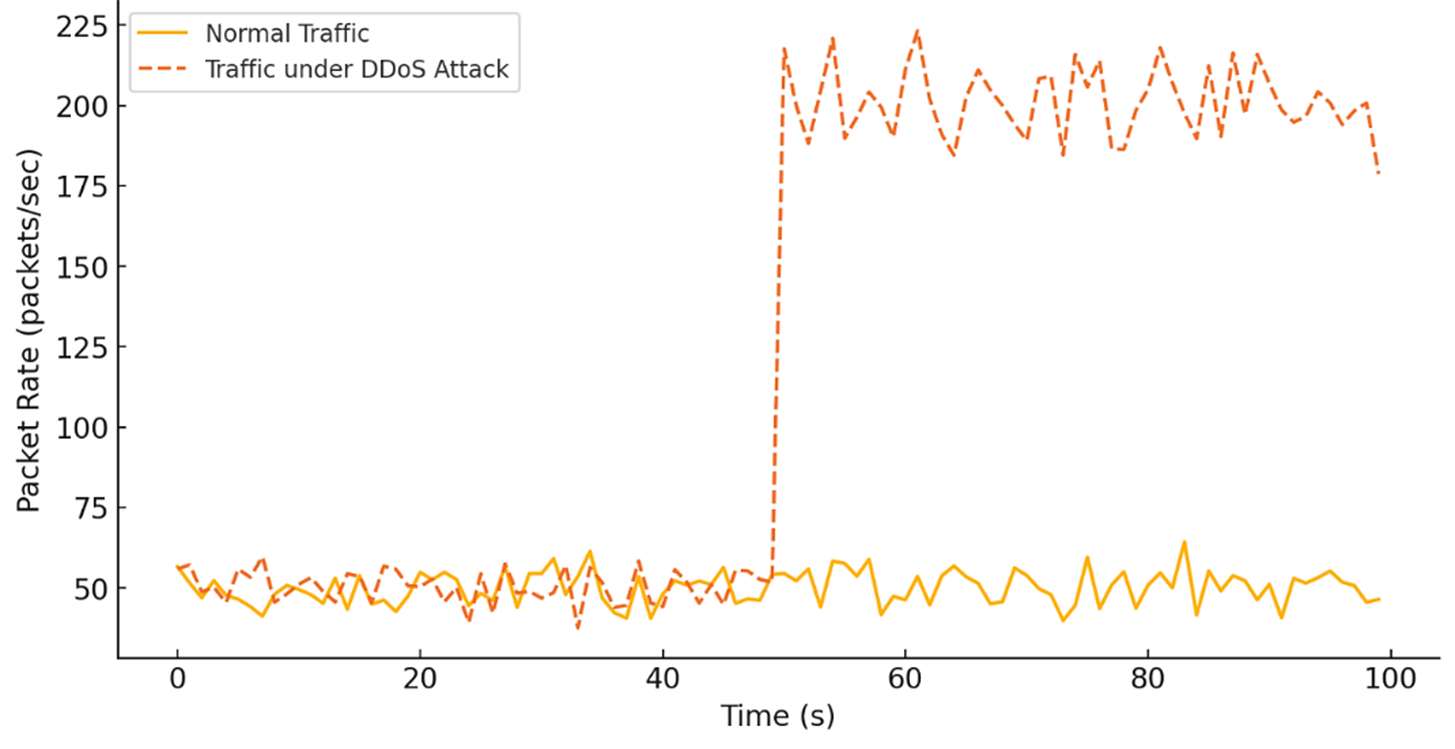
The Internet of Things has grown quickly in the last few years, adding new features to everyday devices while also making those systems more vulnerable to more advanced Distributed Denial-of-Service attacks. Because of this two-sided growth, the current study uses the NS-3 simulator for a detailed traffic analysis that can find and stop DDoS attacks. The experiment used several machine-learning classifiers, including Random Forest, Support Vector Machine, and Long Short-Term Memory, to see how fast and accurate they were. The LSTM (Long Short-Term Memory) model was able to find DDoS attacks in the simulated IoT environment with 98.5% accuracy. This was mostly because it could accurately capture temporal patterns and dependencies in sequential network traffic data. The strategy as a whole lays out a set of security rules that should work well across large IoT networks.
References
G. Sharma, S. Vidalis, N. Anand, C. Menon, and S. Kumar, “A survey on layer-wise security attacks in IoT: Attacks, countermeasures, and open-issues,” Electronics, vol. 10, no. 19, p. 2365, 2021, doi: https://doi.org/10.3390/electronics10192365.
M. bin Farukee, M. S. Z. Shabit, M. R. Haque, and A. H. M. S. Sattar, “DDoS attack detection in IoT networks using deep learning models combined with random forest as feature selector,” in Advances in Cyber Security: Second International Conference, ACeS 2020, Penang, Malaysia, December 8-9, 2020, Revised Selected Papers 2, Springer, 2021, pp. 118–134. doi: https://doi.org/10.1007/978-981-33-6835-4_8.
P. Podder, M. Mondal, S. Bharati, and P. K. Paul, “Review on the security threats of internet of things,” arXiv preprint arXiv:2101.05614, 2021, doi: https://doi.org/10.48550/arXiv.2101.05614.
O. Toutsop, S. Das, and K. Kornegay, “Exploring the security issues in home-based IoT devices through denial of service attacks,” in 2021 IEEE SmartWorld, Ubiquitous Intelligence & Computing, Advanced & Trusted Computing, Scalable Computing & Communications, Internet of People and Smart City Innovation (SmartWorld/SCALCOM/UIC/ATC/IOP/SCI), IEEE, 2021, pp. 407–415. doi: https://doi.org/10.1109/SWC50871.2021.00062.
I. Cvitić, D. Peraković, M. Periša, and M. Botica, “Novel approach for detection of IoT generated DDoS traffic,” Wireless Networks, vol. 27, no. 3, pp. 1573–1586, 2021, doi: https://doi.org/10.1007/s11276-019-02043-1.
R. R. Chowdhury, S. Aneja, N. Aneja, and P. E. Abas, “Packet-level and IEEE 802.11 MAC frame-level network traffic traces data of the D-Link IoT devices,” Data in Brief, vol. 37, p. 107208, 2021, doi: https://doi.org/10.1016/j.dib.2021.107208.
N. Kandhoul, S. K. Dhurandher, and I. Woungang, “Random forest classifier‐based safe and reliable routing for opportunistic IoT networks,” International Journal of Communication Systems, vol. 34, no. 1, p. e4646, 2021, doi: https://doi.org/10.1002/dac.4646.
M. Hosseinzadeh, A. M. Rahmani, B. Vo, M. Bidaki, M. Masdari, and M. Zangakani, “Improving security using SVM-based anomaly detection: issues and challenges,” Soft Computing, vol. 25, no. 4, pp. 3195–3223, 2021, doi: https://doi.org/10.1007/s00500-020-05373-x.
P. L. S. Jayalaxmi, R. Saha, G. Kumar, M. Conti, and T.-H. Kim, “Machine and deep learning solutions for intrusion detection and prevention in IoTs: A survey,” IEEe Access, vol. 10, pp. 121173–121192, 2022, doi: https://doi.org/10.1109/ACCESS.2022.3220622.
J. J. Hathaliya, S. Tanwar, and P. Sharma, “Adversarial learning techniques for security and privacy preservation: A comprehensive review,” Security and Privacy, vol. 5, no. 3, p. e209, 2022, doi: https://doi.org/10.1002/spy2.209.
S. Bharati and P. Podder, “Machine and deep learning for IoT security and privacy: applications, challenges, and future directions,” Security and communication networks, vol. 2022, no. 1, p. 8951961, 2022, doi: https://doi.org/10.1155/2022/8951961.
T. Saba, A. Rehman, T. Sadad, H. Kolivand, and S. A. Bahaj, “Anomaly-based intrusion detection system for IoT networks through deep learning model,” Computers and Electrical Engineering, vol. 99, p. 107810, 2022, doi: https://doi.org/10.1016/j.compeleceng.2022.107810.
S. Deep, X. Zheng, A. Jolfaei, D. Yu, P. Ostovari, and A. Kashif Bashir, “A survey of security and privacy issues in the Internet of Things from the layered context,” Transactions on Emerging Telecommunications Technologies, vol. 33, no. 6, p. e3935, 2022, doi: https://doi.org/10.1002/ett.3935.
G. Yascaribay, M. Huerta, M. Silva, and R. Clotet, “Performance evaluation of communication systems used for internet of things in agriculture,” Agriculture, vol. 12, no. 6, p. 786, 2022, doi: https://doi.org/10.3390/agriculture12060786.
S. Stryczek and M. Natkaniec, “Internet threat detection in smart grids based on network traffic analysis using LSTM, IF, and SVM,” Energies, vol. 16, no. 1, p. 329, 2022, doi: https://doi.org/10.3390/en16010329.
D. A. Baranov, A. O. Terekhin, D. S. Bragin, and A. A. Mitsel, “Simulation of DDoS attacks on LTE and LoRaWAN protocols in the ns-3 network simulator,” in International Conference on High-Performance Computing Systems and Technologies in Scientific Research, Automation of Control and Production, Springer, 2022, pp. 291–301. doi: https://doi.org/10.1007/978-3-031-23744-7_22.
Y. Wang, X. Du, Z. Lu, Q. Duan, and J. Wu, “Improved LSTM-based time-series anomaly detection in rail transit operation environments,” IEEE Transactions on Industrial Informatics, vol. 18, no. 12, pp. 9027–9036, 2022, doi: https://doi.org/10.1109/TII.2022.3164087.
H. Karthikeyan and G. Usha, “Real-time DDoS flooding attack detection in intelligent transportation systems,” Computers and Electrical Engineering, vol. 101, p. 107995, 2022, doi: https://doi.org/10.1016/j.compeleceng.2022.107995.
R. Dilip, N. Samanvita, R. Pramodhini, S. G. Vidhya, and B. S. Telkar, “Performance Analysis of Machine Learning Algorithms in Intrusion Detection and Classification,” in International Conference on Emerging Technologies in Computer Engineering, Springer, 2022, pp. 283–289. doi: https://doi.org/10.1007/978-3-031-07012-9_25.
IEEE NS-3 Team, “NS-3 Network Simulator Overview,” [Online]. Available: [https://www.nsnam.org](https://www.nsnam.org), 2023.
S. S. Mehjabin et al., “A Networked System Dependability Validation Framework Using Physical and Virtual Nodes,” IEEE Access, vol. 11, pp. 127242–127254, 2023, doi: https://doi.org/10.1109/ACCESS.2023.3330688.
F. W. Romadhon, M. A. U. Nuha, Y. Adiprawira, and R. F. Sari, “Comparative Analysis of HAProxy and Nginx Load Balancers in Mitigating User Datagram Protocol (UDP) Flood Attacks,” in 2024 12th International Conference on Information and Communication Technology (ICoICT), IEEE, 2024, pp. 354–359. doi: https://doi.org/10.1109/ICoICT61617.2024.10698656.
A. v Jha, D. K. Gupta, B. Appasani, S. K. Mishra, and W. Bhowmik, “Modelling and Simulation Approach of DoS Attack for the Synchrophasor Communication Network Using NS-3,” in 2024 IEEE 4th International Conference on Applied Electromagnetics, Signal Processing, & Communication (AESPC), IEEE, 2024, pp. 1–6. doi: https://doi.org/10.1109/AESPC63931.2024.10872402.
P. SENTHILRAJA, P. NANCY, J. SHERINE GLORY, and G. MANISHA, “Enhancing IoT security in wireless local area networks through dynamic vulnerability scanning,” Sādhanā, vol. 49, no. 3, p. 195, 2024, doi: https://doi.org/10.1007/s12046-024-02534-8.
R. Lamptey, M. Saedi, and V. Stankovic, “Machine-Learning Anomaly Detection for Early Identification of DDOS in Smart Home IoT Devices,” 2025.
J. Meka, A. Jain, and N. Kumar, “A Holistic Approach to DDoS Mitigation: Leveraging NS-3 Simulation and Traceback for Enhanced Network Resilience,” in 2025 International Conference on Innovation in Computing and Engineering (ICE), IEEE, 2025, pp. 1–6. doi: https://doi.org/10.1109/ICE63309.2025.10983918.
J. R. KHAN, S. M. KHAN, and F. A. SIDDIQUI, “Investigative Analysis of Vulnerabilities and Attacks on Underwater Wireless Sensor Networks,” Adhoc & Sensor Wireless Networks, vol. 60, 2025, doi: 10.32908/ahswn.v60.10299.
Downloads
Published
How to Cite
Issue
Section