Wireless Power Transfer for Biomedical Implants using Series–Parallel Spider-Web Coil Configuration
DOI:
https://doi.org/10.51173/eetj.v2i2.30Keywords:
Biomedical Implant, Magnetic Resonance Coupling, Spider Web Coil, Near˗field TransmissionAbstract
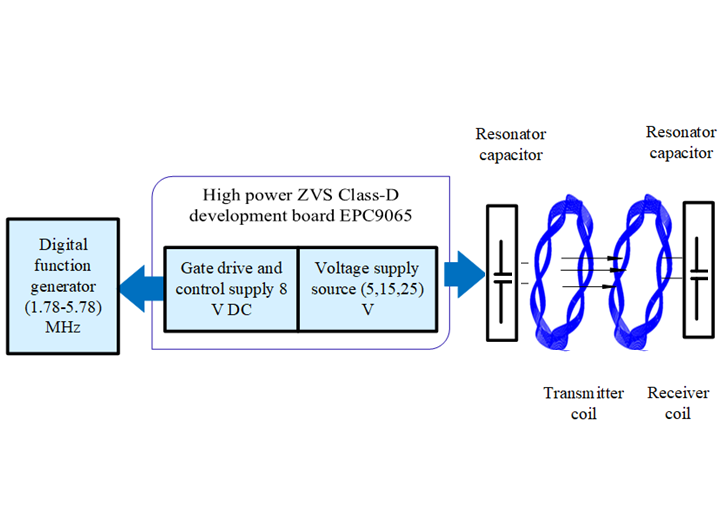
Biomedical sensors and implants are regarded as a significant technology for improving the quality of healthcare, as they enable proactive illness management and ongoing monitoring of the patient vital signs. Like many other devices, they are restricted to a limited amount of energy, and this leads to a challenge in terms of the lifespan of the device. This study aims to address this issue by designing and implementing a wireless energy transmission system specifically designed for such devices. The proposed design is based on utilizing spider-web and the series–parallel configuration to provide sufficient energy transmission for the device. The model has been examined under various conditions, including changes to the transmission distance between coils, the source voltage level, and operating frequency. Examined performance metrics including the output DC voltage and power transfer, as well as the overall efficiency of power transfer, proving that the strategy is feasible. As many biomedical implants such as pacemakers required 5 volts to operate, the study target voltage was 5 V. Two source voltages (10, and 20 V) were demonstrated. The design was examined at six operating frequencies, ranging from 1.78 MHz to 6.78 MHz. The most acceptable results were achieved at 1.78 MHz. Power transfer efficiencies at a 10 mm transmission distance were 91.5% and 91.15% for source voltages of 10 V and 20 V, respectively. The proposed design demonstrates high efficiency which is appropriate for powering BMI wirelessly.
References
P. K. Chittoor, B. Chokkalingam, and L. Mihet-Popa, "A review on UAV wireless charging: Fundamentals, applications, charging techniques and standards," IEEE access, vol. 9, pp. 69235-69266, 2021.
A. Sagar, A. Kashyap, M. A. Nasab, S. Padmanaban, M. Bertoluzzo, A. Kumar, et al., "A comprehensive review of the recent development of wireless power transfer technologies for electric vehicle charging systems," Ieee Access, vol. 11, pp. 83703-83751, 2023.
H. K. Abduljaleel and S. K. Gharghan, "Wireless power transfer-based single layer inductive coupling for biomedical implantable devices," in AIP Conference Proceedings, 2024, p. 050028.
A. Ghafari, E. Mohammadi, M. Dastjerdi, S. Honarmand, Z. A. Radmoghadam, and S. Akbari, "Batteries applications in the biomedical industry: A review," 2023.
M. Haerinia and R. Shadid, "Wireless power transfer approaches for medical implants: A review," Signals, vol. 1, pp. 209-229, 2020.
K. Detka and K. Górecki, "Wireless power transfer—a review," Energies, vol. 15, p. 7236, 2022.
A. M. Jawad, R. Nordin, S. K. Gharghan, H. M. Jawad, and M. Ismail, "Opportunities and challenges for near-field wireless power transfer: A review," Energies, vol. 10, p. 1022, 2017.
J. Soleimani and G. Karabulut Kurt, "High‐power radio frequency wireless energy transfer system: Comprehensive survey on design challenges," IET Wireless Sensor Systems, vol. 14, pp. 248-264, 2024.
A. I. Mahmood, S. K. Gharghan, M. A. Eldosoky, and A. M. Soliman, "Near‐field wireless power transfer used in biomedical implants: A comprehensive review," IET Power Electronics, vol. 15, pp. 1936-1955, 2022.
S. Roy, A. W. Azad, S. Baidya, M. K. Alam, and F. Khan, "Powering solutions for biomedical sensors and implants inside the human body: A comprehensive review on energy harvesting units, energy storage, and wireless power transfer techniques," IEEE Transactions on Power Electronics, vol. 37, pp. 12237-12263, 2022.
M. F. Mahmood, S. L. Mohammed, S. K. Gharghan, A. Al-Naji, and J. Chahl, "Hybrid coils-based wireless power transfer for intelligent sensors," Sensors, vol. 20, p. 2549, 2020.
D. Ahire, V. J. Gond, and J. J. Chopade, "Coil material and magnetic shielding methods for efficient wireless power transfer system for biomedical implant application," Biosensors and Bioelectronics: X, vol. 10, p. 100123, 2022.
A. I. Mahmood, S. K. Gharghan, M. A. Eldosoky, and A. M. Soliman, "Wireless charging for cardiac pacemakers based on class‐D power amplifier and a series–parallel spider‐web coil," International Journal of Circuit Theory and Applications, vol. 51, pp. 1-17, 2023.
A. I. Mahmood, S. K. Gharghan, M. A. Eldosoky, and A. M. Soliman, "Powering Implanted Devices Wirelessly Using Spider-Web Coil," Journal of Techniques, vol. 5, pp. 28-34, 2023.
M. F. Mahmood, S. K. Gharghan, S. L. Mohammed, A. Al-Naji, and J. Chahl, "Design of powering wireless medical sensor based on spiral-spider coils," Designs, vol. 5, p. 59, 2021.
A. I. Mahmood, S. K. Gharghan, M. A. Eldosoky, M. F. Mahmood, and A. M. Soliman, "Wireless power transfer based on spider web–coil for biomedical implants," IEEE Access, vol. 9, pp. 167674-167686, 2021.
S. Mutashar, M. A. Hannan, S. A. Samad, and A. Hussain, "Analysis and optimization of spiral circular inductive coupling link for bio-implanted applications on air and within human tissue," Sensors, vol. 14, pp. 11522-11541, 2014.
D. He, Y. Cui, F. Ming, and W. Wu, "Advancements in passive wireless sensors, materials, devices, and applications," Sensors, vol. 23, p. 8200, 2023.
Downloads
Published
How to Cite
Issue
Section